
Origin: The Mingol Steppes

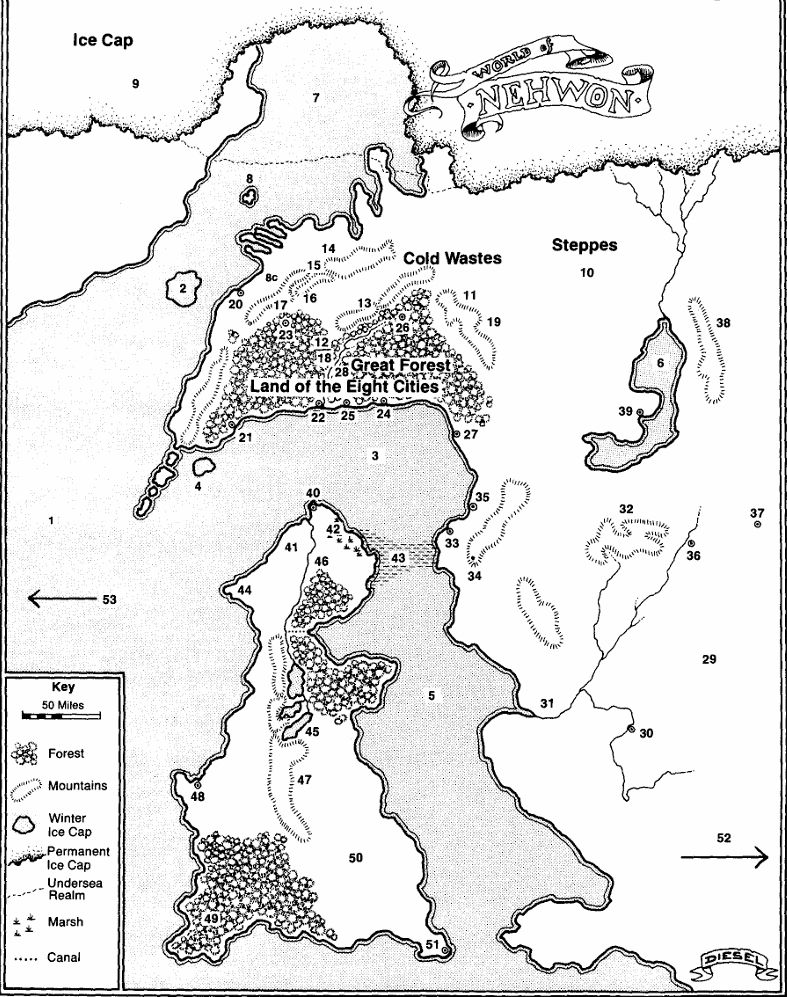
Lowland grassy plains sweep out endlessly to the east, taking up a vast patch of northern Nehwon. Here the Mingol tribes roam this northeastern land, claiming the region of the world from the northern ice cap to the Empire of Eevamarensee in the southeast.
The Mingol people are considered savages by the people of the civilized south and west. Banding together in nomadic tribes of horse-mounted warriors that protect their women, children and tent-villages, the Mingols are renowned for their aggressive attitudes towards foreigners. Intruders into a war band’s territory are captured, enslaved and in the case of women, ravaged. Some men are simply cut down in battle by a thunderous horse-charge, lanced through the chest by a crudely made spear or slain by an expertly swung scimitar.
In all of Nehwon, no people are considered more hostile and barbarous than the Mingols. Open warfare is not unknown between the Steppes hordes and both the Land of the Eight Cities and Lankhmar. Each assault is repelled, usually at great cost and many scholars wonder just what the horseback nomads really desire out of such war, if there even is any desire beyond the thrill of bloodshed and the barbaric honor of killing others. When the Mingols are not openly at war with other nations (and it can be a hard thing to judge) roaming bands attack settlements intent on plunder, pillage and murder.
Battle between the Mingol tribes is also a common occurrence. Travelers moving through the Great Steppes have reported many times of seeing skirmishes between Mingol tribes, with the stocky plains ponies of the nomads carrying dozens or hundreds of shrieking warriors into battle. It is said in Lankhmar that swords clink together as often as coins. In the wild plains of the Great Steppes, any clashing metal is always sword or axe against blade or armor – little trade ever goes on between the tribes and the rest of Nehwon.
It is a misrepresentation to assume all Mingols in Nehwon are simply violent barbarians. For all their warlike nature and reputation as fearsome blood-letters, Mingols can be prodigious travelers and explorers, curious about other nations and climes rather than burning with the desire to invade them. Mingols encountered in the civilized lands to the south and west of the Steppes make livings as cartographers, explorers, traders, craftsmen and sell-swords much like anyone else. Lankhmar, as a haven for any and all people on both sides of the law, attracts many Mingols, drawn by the dual lure of decadent civilization. The Imperishable City boasts more than a few Mingol-born traders, sailors and thieves, as well as a horde of slaves put into indentured servitude for their crimes in the city or as prisoners of war.
The Mingol hordes are akin to the Mongols of our world and are seen through western eyes as little more than barbarous warrior nomads. This is a stereotype but an effective one and can make for some fear-inspiring enemies on the walls of a city or in the bitter house-to-house fighting that floods the streets of a besieged town.
Mingols will fight ferociously but are not without their own code of honor. They are loath to break oaths, for example. Ourph, Fafhrd and the Grey Mouser’s Mingol slave, experienced great unease when he was allowed to go back on a promise, though he ultimately decided against violating his oath of service. Despite their apparent honor system, the Mingols are well known for the torture they inflict upon captives. Games Masters might choose to have a reason beyond barbarism or sadism for this behavior. For example, perhaps the Mingols torture their war prisoners not out of sadistic glee or spite but because they believe that the more pain one suffers in death, the higher a man’s rewards in the afterlife. As such, they reserve their greatest tortures and agonies for those they respect the most.
In the end, Games Masters might decide that a belief like this lends too much of an air of sympathy to enemies that are acknowledged as raping, pillaging and razing the people and towns of the Land of the Eight Cities. Irredeemably evil antagonists are a powerful trope of Sword & Sorcery and can easily be used effectively here. Perhaps the best examples of this are saved for the warriors that spill into human lands from the City of Ghouls.
Mingols, as their name suggests, are similar to the Mongols of Earth and share identical physical and cultural characteristics. The Mingols hail from the Steppes and are divided into two cultural branches. The Horse Mingols still call the Steppes home and are renowned horsemen. Nomadic in nature, these Mingols build no permanent cities and prize wood almost as much as silver and gold. The other Mingol branch is the Sea Mingols, adept sailors and pirates who ply the waters of both the Inner and Outer Seas, raiding and trading.
The Steppes: The Steppes are a huge region of grassy plains extending far to the east of the known lands. This is the land of the Mingols, the savage breed of nomadic horsemen who often terrorize the more civilized lands of Nehwon. The northern border of the Steppes is generally considered to be the polar ice cap, while the southern border is blocked by the Sea of Monsters and Eevanmarensee.
Mingols are nomads, and their villages are generally established for one year. If timber is available, a stout log barricade is usually erected around the village; otherwise, the Mingols dig earthen breastworks. Although wars between tribes of Mingols are not uncommon, the truly fearsome power of this race is revealed only when the tribes combine to perform a mass invasion of adjoining civilized lands.
Travelers across the Steppes are very likely to meet bands of marauding Mingols. Encounters with these savage folk in their own territory always lead to bloodshed. However, the Mingols have great respect for fighting prowess, and there is a chance that a captive who proves himself superior in combat to one or more Mingol champions might be allowed to go free.



Comments